
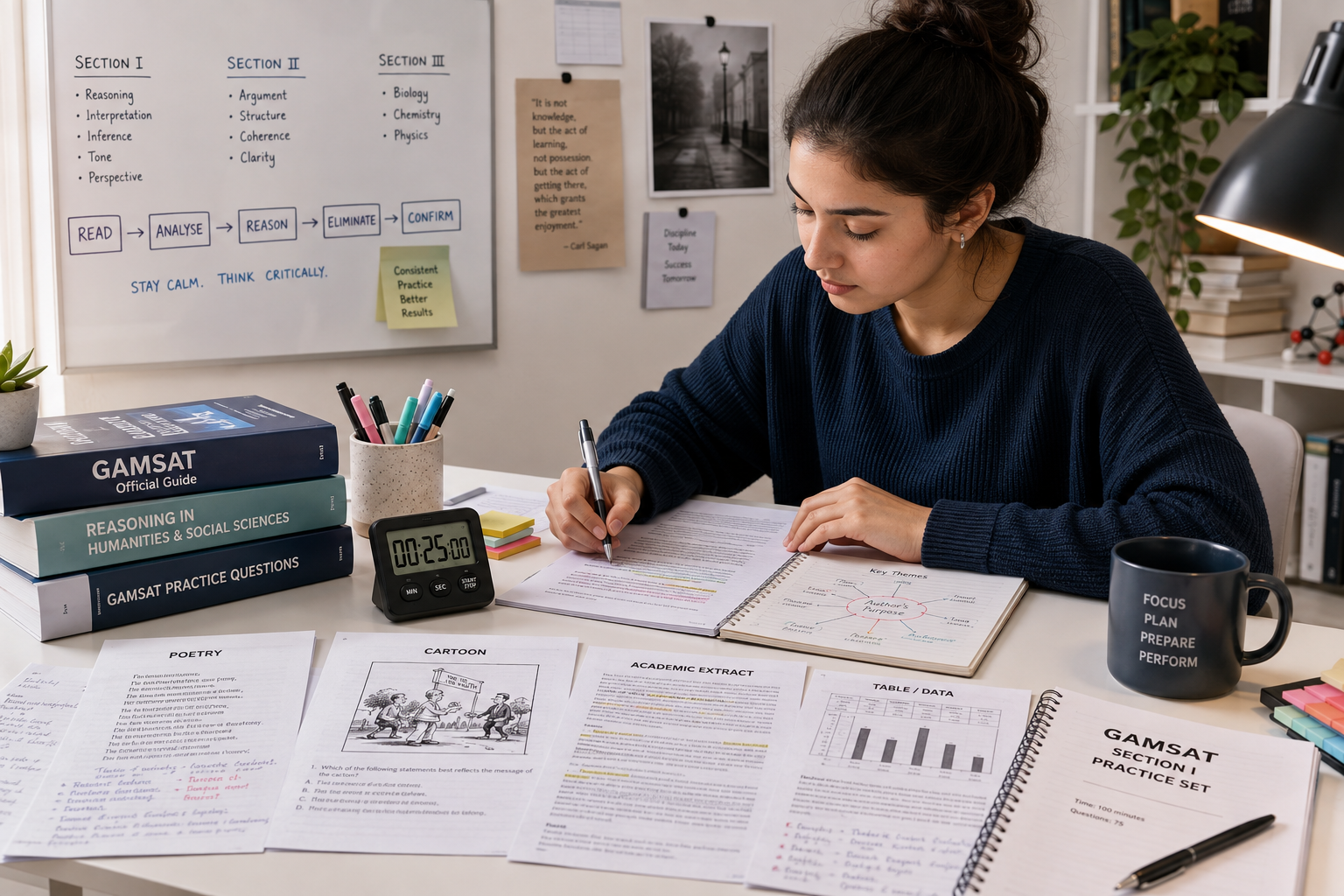
GAMSAT Section I, also known as Reasoning in Humanities and Social Sciences, is designed to test how well candidates can understand, interpret, and analyse different types of written and visual material. The section may include passages, poems, cartoons, quotes, tables, and other unfamiliar texts, followed by multiple-choice questions. While it may appear to be a simple reading-based section, the real challenge lies in identifying meaning, understanding tone and perspective, making logical inferences, and choosing the most appropriate answer under time pressure. For many GAMSAT aspirants, Section I becomes difficult because several answer choices can seem correct, making strong reasoning and careful interpretation essential.
What GAMSAT Section 1 Actually Tests
Officially, Section I is Reasoning in Humanities and Social Sciences. Most candidates face somewhere around 65–75 questions in 100 minutes under 90 seconds per question once you account for reading time.The stimulus material is deliberately varied: academic extracts, opinion pieces, poetry, cartoons, tables, and short fiction. None of it requires prior subject knowledge. What it requires is the ability to extract meaning, follow an argument, notice tone, and spot what’s implied rather than stated outright all quickly, and all without the comfort of familiar content to lean on.This is why treating Section I as “just reading comprehension” is the most common and costly mistake candidates make.
Step 1: Understand Why This Section Trips People Up
Most students who underperform on Section I aren’t struggling with literacy. They’re struggling with three things specifically:
- Pace. Under 90 seconds per question doesn’t leave room to re-read a passage twice. You need to extract what you need on the first pass.
- Unfamiliar formats. GAMSAT deliberately uses material outside typical exam prep satire, historical essays, abstract poetry so pattern-matching to “the kind of text I usually see” doesn’t work.
- Distractor answers. GAMSAT multiple-choice options are built to sound plausible. The skill isn’t just finding a correct answer it’s confidently eliminating close-but-wrong ones.
Once you name these as the real obstacles, your preparation can target them directly instead of just “doing more reading.”
Step 2: Practise Actively, Not Passively
Reading widely helps, but reading alone won’t move your score much. The gap between casual reading and GAMSAT-ready reasoning is built through active practice:
- Annotate as you read. Mark shifts in tone, the writer’s underlying argument, and places where meaning is implied rather than stated. This forces you to engage with structure, not just content.
- Diversify your stimulus material. Rotate between prose, poetry, cartoons, opinion pieces, and academic extracts. Repeatedly drilling the same passage type builds false confidence in a narrow skill.
- Practise elimination, not just selection. For every question, get in the habit of explaining why the three wrong answers are wrong, not just why the right one is right. This is where distractor-resistance actually develops.
- Time yourself early. Don’t wait until a few weeks out to introduce timing. Pacing instincts take time to build, and practising untimed early on creates a false sense of readiness.
Step 3: Build a Structured Weekly Routine
Section I responds well to consistency over intensity. A useful weekly rhythm:
- Daily short passages (15–20 minutes) to keep reasoning skills active without burning out.
- Weekly full-length timed sets to build stamina and simulate real exam pressure.
- Regular review sessions where you categorise mistakes was it a tone misread, a structural misunderstanding, a rushed elimination, or a genuine comprehension gap? Tracking this over weeks shows you exactly where your preparation needs to shift.
This mirrors how the section is actually assessed: not as a single skill, but as a set of related reasoning habits that need separate attention and separate correction.
Step 4: Learn to Read Between the Lines Efficiently
A large share of Section I questions hinge on inference what a passage implies rather than what it directly says. This is a trainable skill, not a fixed trait. Practical ways to build it:
- After reading a passage, pause and summarise the author’s underlying position in one sentence before looking at the questions.
- Notice where tone shifts within a passage — irony, hesitation, or a change in stance are common places GAMSAT builds questions around.
- With cartoons and visual stimuli, treat them the same way you would a written argument: identify the implied message, not just the literal image.
The goal is to make “reading for the argument beneath the words” an automatic habit rather than something you have to consciously force under time pressure.
Common Mistakes to Avoid
- Treating Section I as a speed-reading test. Speed matters, but accuracy in reasoning matters more rushing without engaging properly with the argument tends to backfire.
- Only practising with official ACER-style material. While useful, relying solely on one source limits your exposure to the range of tones and formats the real exam uses.
- Skipping past wrong answers without review. Moving on quickly after a practice set feels productive, but the real score gains come from understanding why an answer was wrong.
- Under-preparing relative to Section III. Many science-background students focus their energy on Section III and treat Section I as secondary. Since all sections count, this imbalance often costs more than it saves.
How Long Should You Spend on Section 1 Preparation?
Most students see meaningful improvement with 8–12 weeks of consistent, structured practice, ideally running alongside not after Science preparation. Reasoning skills build gradually with repetition and feedback, so starting early and staying consistent tends to outperform short, intense bursts of last-minute practice.
Getting Structured Support
Because Section I so heavily rewards feedback knowing why you missed a question, not just that you did many students find guided practice speeds up progress considerably. ACAMEDICA Coaching’s GAMSAT English Course is built around exactly this: a mix of prose, poetry, and cartoon-based practice material, worked solutions, live tutoring, GAMSAT strategy sessions, and full-length mock exams, so your Section I preparation stays structured and consistently reviewed rather than left to guesswork.
Final Thoughts
Section I isn’t testing what you know it’s testing how well you reason with the unfamiliar, under pressure, and how confidently you can defend your answer choices. Build active reading habits, diversify your practice material, time yourself early, and review your mistakes with real discipline. Approached this way, Section I stops being the section that quietly costs students marks, and becomes one you can walk into with a genuine strategy.

