
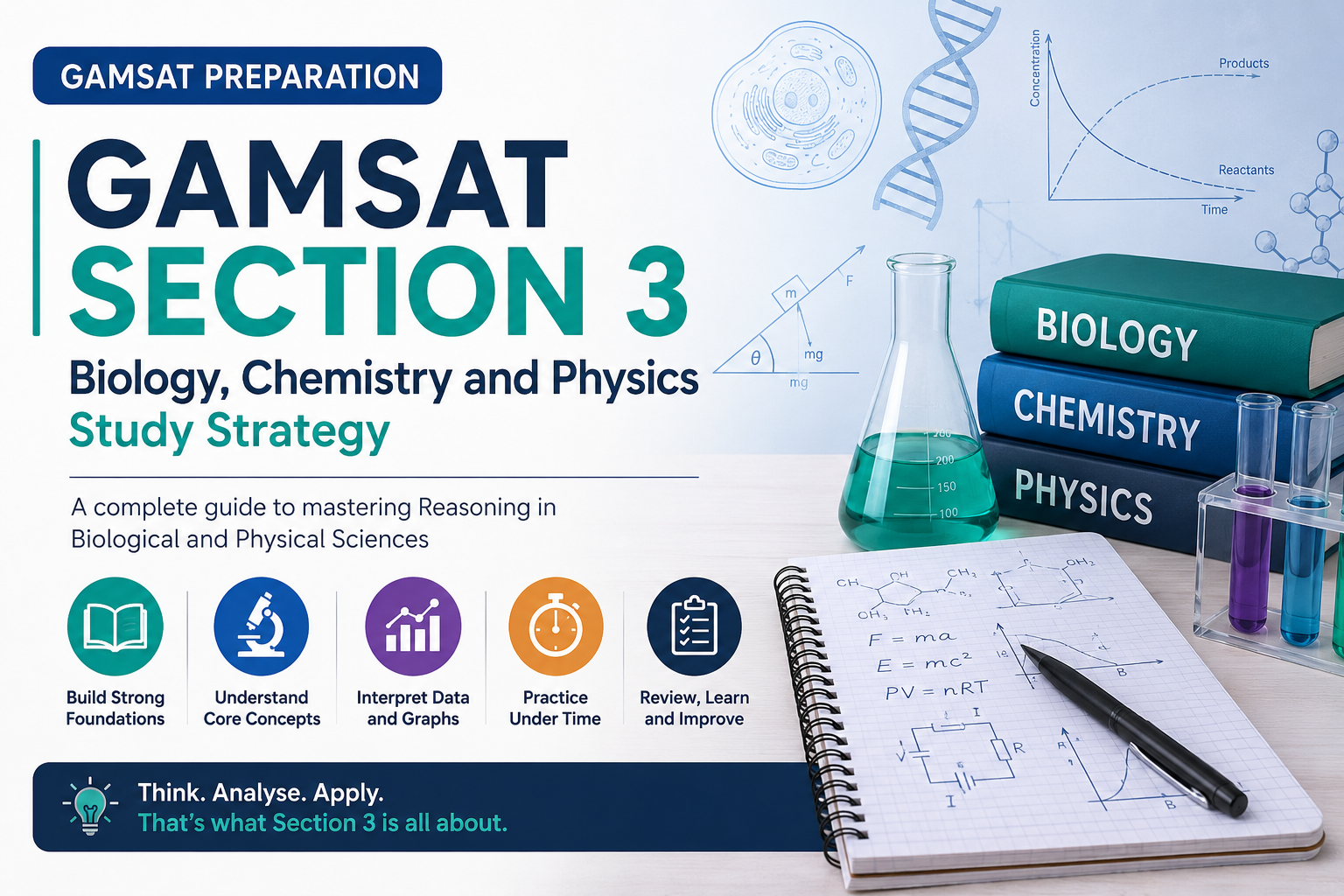
For most GAMSAT candidates,GAMSAT Section III is often considered one of the most challenging parts of the exam because it tests much more than a student’s knowledge of science. Aspirants are expected to interpret unfamiliar information, analyse graphs and data, apply scientific concepts, and solve complex problems within a limited time. Even students with a strong background in biology, chemistry, or physics may struggle if they rely mainly on memorisation instead of logical reasoning and problem-solving skills. Understanding the common challenges faced in GAMSAT Section III can help aspirants identify their weak areas, improve their preparation strategy, and approach the exam with greater confidence.
What GAMSAT Section 3 Actually Tests
Section III is officially called Reasoning in Biological and Physical Sciences. Candidates typically face around 75 multiple-choice questions in 170 minutes, drawing on first-year university level Biology, Chemistry (both physical and organic), and Physics.
The key thing to understand is that ACER isn’t testing whether you remember the periodic table or Newton’s laws by heart. Most questions present unfamiliar data, an experimental scenario, a graph, or a passage of scientific text, and ask you to apply core concepts to work out the answer. This is why students with strong content knowledge can still underperform the exam is really testing scientific reasoning, not content recall.
That distinction should shape everything about how you prepare.
Step 1: Build a Solid Content Foundation First
Before you can reason your way through an unfamiliar GAMSAT-style question, you need the underlying concepts to be second nature. Trying to apply knowledge you haven’t properly consolidated just adds another layer of difficulty under time pressure.
A practical approach:
- Map the syllabus first. Section III draws heavily on first-year Biology, Chemistry, and Physics. Identify the specific topics ACER tends to test (cell biology, genetics, physical and organic chemistry fundamentals, mechanics, electricity, and thermodynamics are recurring areas) rather than trying to relearn an entire degree.
- Prioritise by return on effort. Some topics appear far more frequently than others. Spend proportionally more time on high-yield areas like chemical equilibrium, energetics, cell processes, and core physics formulas.
- Use short, focused study blocks. Content review works best in 45–60 minute sessions per subject, rotating between Biology, Chemistry, and Physics rather than spending entire days on one subject. This keeps all three areas active in your memory simultaneously, which matters because the real exam mixes them without warning.
Step 2: Study Each Subject With a Different Lens
Biology, Chemistry, and Physics each reward a slightly different preparation style.
Biology
GAMSAT Biology questions often hinge on interpreting unfamiliar diagrams, experimental setups, or data tables rather than recalling isolated facts. Focus on understanding processes – how systems interact, how one variable affects another rather than memorising lists of terms. Practising with diagrams you haven’t seen before is more valuable than re-reading notes.
Chemistry (Physical and Organic)
Chemistry tends to be the most calculation-heavy of the three. Physical chemistry concepts like equilibrium, thermodynamics, and reaction rates come up repeatedly, often combined with graph interpretation. Organic chemistry questions usually test your ability to predict reaction outcomes or identify functional group behaviour rather than name complex structures. Build fluency with core reaction types and practise reading concentration/rate graphs quickly and accurately.
Physics
Physics in the GAMSAT rewards formula fluency and the ability to apply the right equation to a described scenario. Mechanics, electricity and magnetism, and waves/thermodynamics are common territory. Rather than memorising formula sheets passively, practise deriving which formula applies from a written scenario that translation step is exactly what the exam tests.
Step 3: Shift From Content Review to Applied Practice
This is the stage where most students plateau if they stay in “textbook mode” too long. Once your foundations are reasonably solid, the highest-value activity becomes working through GAMSAT-style questions ideally ones involving graphs, data sets, and unfamiliar contexts.
A few principles to keep in mind:
- Practise interpreting data, not just solving equations. A large share of Section III questions present a graph or table and ask you to extract or extrapolate information. This is a learnable skill, and it improves fastest through repetition with feedback.
- Time yourself from early on. With roughly 75 questions in under three hours, you have limited time per question. Practising untimed builds false confidence – introduce timing early so pacing becomes instinctive rather than something you’re managing consciously on exam day.
- Review every wrong answer properly. Don’t just check whether you got a question right. Work out why you got it wrong – was it a content gap, a misread graph, a rushed calculation, or a reasoning error? Categorising your mistakes tells you exactly where to focus your next study session.
Step 4: Use Mock Exams to Build Stamina and Strategy
Full-length, timed mock exams are one of the most underused tools in GAMSAT preparation. Section III is long, dense, and mentally demanding, and stamina is a real factor in performance – many students who understand the content still lose marks in the final third of the section simply because focus drops.
Aim to sit multiple full-length practice exams under realistic conditions in the lead-up to test day. After each one, spend as much time reviewing your mistakes as you did sitting the exam itself. This review process, more than the sitting itself, is where score improvements actually happen.
Common Mistakes to Avoid
- Over-focusing on one subject. Some students lean into their academic background (a biology graduate spending most of their time on biology, for example) while neglecting weaker areas. Section III rewards balance across all three subjects.
- Passive revision. Re-reading notes or watching lecture content without active practice questions creates a false sense of readiness.
- Ignoring graph and data questions. These appear throughout the section and are highly practicable, yet many students under-prepare for them specifically.
- Leaving mock exams too late. Stamina and pacing need to be built up over time, not tested for the first time a few weeks before the exam.
How Long Should You Spend on Section 3 Preparation?
Most students benefit from three to four months of consistent, structured preparation, though this depends on your starting science background. Non-science graduates often need more time on foundational content before shifting into applied practice, while science graduates may move to practice questions sooner but still need dedicated time on reasoning and pacing.
Getting Structured Support
Self-study can absolutely work, but many students find that structured Guidance clear topic sequencing, marked practice, and expert feedback on where reasoning breaks down – helps them prepare more efficiently and with more confidence. ACAMEDICA Coaching’s GAMSAT Science Course is built around exactly this approach: covering Biology, Chemistry, and Physics through structured lessons, thousands of practice and graph-based questions, live tutoring, and full-length mock exams, so preparation stays organised instead of scattered.
Final Thoughts
Section III rewards students who move beyond memorisation and build genuine scientific reasoning under time pressure. Cover your content foundations early, shift into applied and timed practice as soon as you can, and use mock exams and careful review to sharpen both accuracy and pacing. With a structured plan and consistent practice, Section III becomes far more manageable – and a real opportunity to strengthen your overall GAMSAT score.

